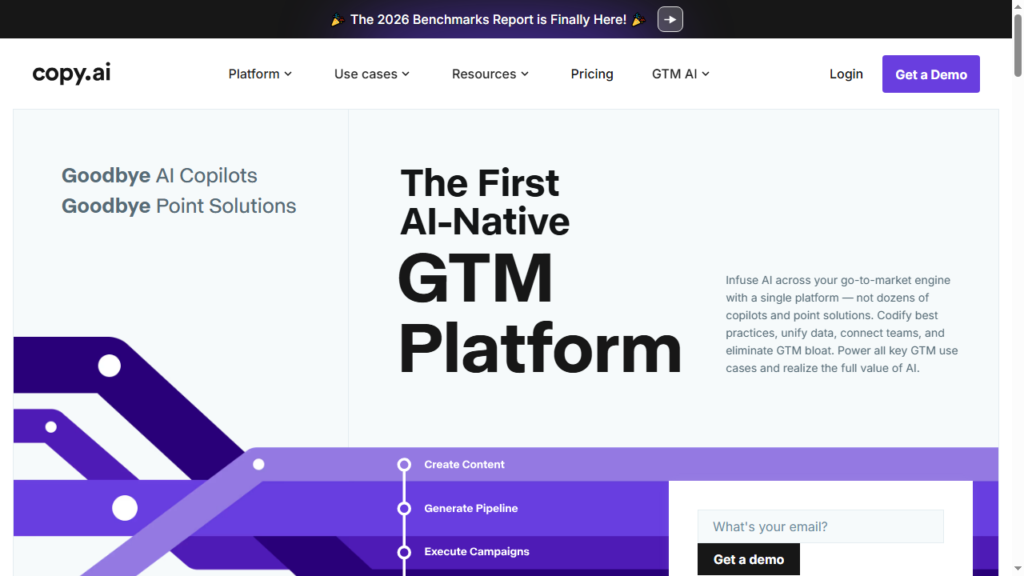
In this exhaustive Copy.ai review, we analyze whether Copy.ai has successfully evolved from a simple generative writing assistant into a full-scale AI marketing automation and go-to-market (GTM) workflow platform capable of replacing manual content production. In today’s competitive digital landscape, modern marketing, demand generation, and sales development teams no longer need isolated chatbots that draft generic social media posts. Instead, organizations demand automated end-to-end pipelines that ingest prospect data, apply calibrated brand voice guidelines, and publish high-converting copy across multiple enterprise channels without human bottlenecking.
As detailed in our Copy.ai directory listing, the platform has fundamentally shifted focus from individual copywriting templates toward scalable operational workflows. While traditional writing tools like Jasper AI and Notion AI continue to focus on manual drafting in document editors, Copy.ai emphasizes multi-step API chains and bulk data enrichment. In this complete evaluation, we investigate how Copy.ai operates, its proprietary Brand Voice and Infobase architecture, real-world marketing workflows, transparent pricing tiers, and how it holds up against top industry alternatives.
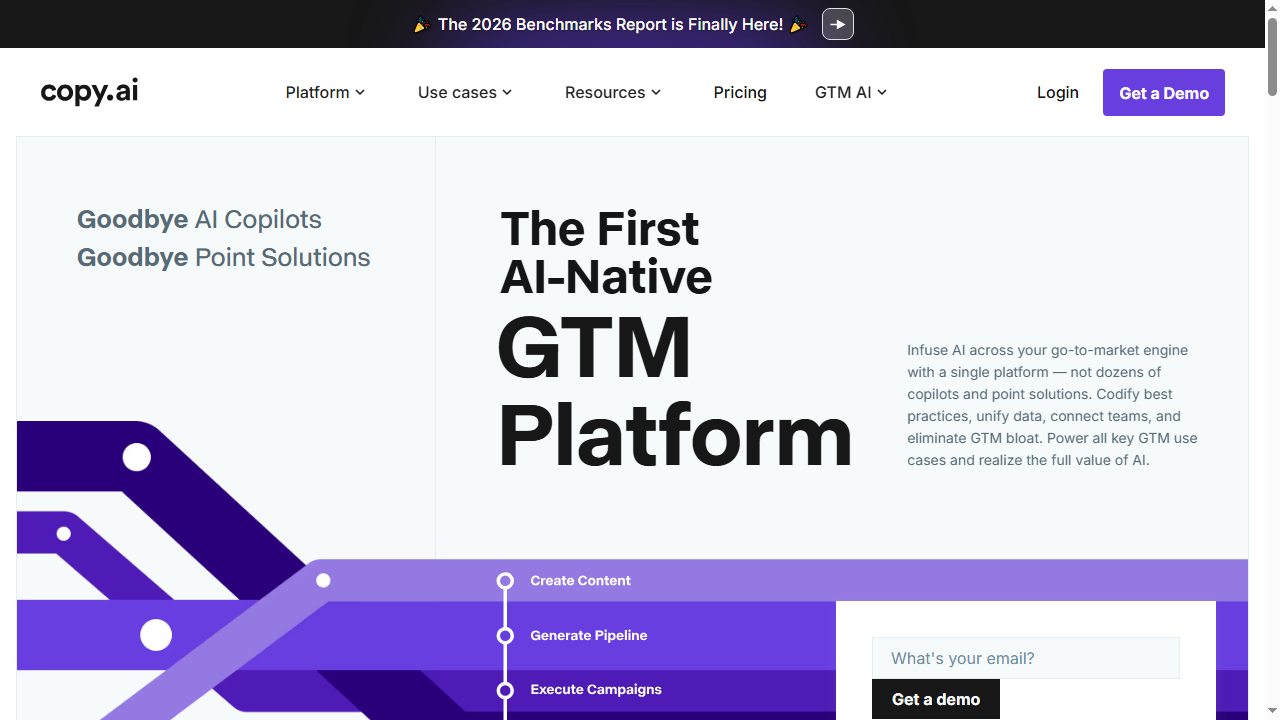
The Evolution: From Chat Prompts to Automated GTM Workflows
When Copy.ai originally launched, it operated primarily as a lightweight front-end for GPT-3 prompt engineering, providing marketers with quick access to dozens of single-purpose templates for Instagram captions, subject lines, and blog outlines. However, as frontier language models became commoditized, marketing leadership realized that standalone prompt generators created organizational chaos: disparate team members generated inconsistent copy, brand tone drifted wildly, and manual copy-pasting consumed valuable working hours.
In response, Copy.ai underwent a comprehensive architectural overhaul, introducing the AI Workflows engine. Rather than interacting with a conversational chat interface one message at a time, users construct structured operational pipelines. A workflow functions like an intelligent visual flowchart: you define inputs (such as an uploaded spreadsheet of target accounts or a newly published webinar recording), orchestrate consecutive LLM transformation steps, integrate live web search data, and automatically push finished outputs directly into your CRM, marketing automation system, or CMS.
Core Architecture: Infobase, Brand Voice, and Model Orchestration
The effectiveness of Copy.ai rests upon three foundational technical pillars that ensure outputs remain accurate, on-brand, and operationally integrated:
1. The Company Infobase
One of the most persistent weaknesses of general conversational chatbots is the lack of company context. Every time you open a new chat window in standard tools, you must remind the AI who your target personas are, what your product pricing looks like, and what competitive differentiators set you apart. Copy.ai solves this through its Infobase repository. Here, teams upload their canonical company truth: ideal customer profiles (ICPs), product feature matrices, case study summaries, customer testimonials, and competitive battlecards. Whenever an automated workflow executes, it dynamically retrieves relevant facts from the Infobase, ensuring that claims, product specs, and value propositions are always verified and consistent.
2. Brand Voice Calibration
AI-generated content often suffers from recognizable synthetic clichés—overusing words like “delve,” “game-changing,” “seamless,” and “unleash.” Copy.ai’s Brand Voice engine eliminates this problem. You can scan existing marketing materials—such as top-performing blog articles, customer emails, or founder letters—and the platform analyzes tone, vocabulary, sentence length, and formatting cadence. You can create multiple distinct brand voices for different segments: for example, a punchy, technical voice for developer documentation, an authoritative, professional voice for enterprise whitepapers, and a casual, empathetic voice for customer support.
3. Multi-Model LLM Orchestration
Rather than chaining your workflows to a single proprietary model, Copy.ai dynamically orchestrates multiple top-tier models behind the scenes, including Claude 3.5 Sonnet, GPT-4o, and specialized open-source architectures. When a workflow step requires deep logical reasoning or complex synthesis, it routes the prompt to Claude; when a task demands speed or concise structuring, it leverages lightweight models. This multi-model routing delivers optimal quality while preserving processing speed.
Key Capabilities and Production Features
- AI Workflows Canvas: A visual builder that connects data triggers, search actions, LLM prompt nodes, and API webhooks into unified automation chains.
- Bulk Data Processing: Upload spreadsheets containing thousands of rows (e.g., conference attendees, competitor URLs, or product SKUs) and execute multi-step workflows against every row simultaneously.
- Web Scraping and Live Research: Incorporate live web search nodes that read competitor websites, extract recent press releases, and synthesize real-time company updates into your copy.
- 90+ Specialized Copywriting Frameworks: Access pre-built modules for proven direct-response frameworks, including AIDA (Attention, Interest, Desire, Action), PAS (Problem, Agitate, Solve), Before-After-Bridge, and high-CTR social hooks.
- Native Enterprise Integrations: Connect directly with HubSpot, Salesforce, Slack, Webflow, Zapier, Make, and Google Workspace to push finished copy into production systems.
Hands-On Implementations: Real-World Marketing Workflows
To see how modern marketing organizations leverage Copy.ai, here are three high-impact workflows implemented by demand generation and content teams:
Workflow 1: Account-Based Marketing (ABM) Prospect Research & Personalized Outreach
An enterprise SDR team targets 250 high-value B2B accounts. Manually researching each company’s recent news, strategic initiatives, and key decision-makers takes 20 to 30 minutes per account. In Copy.ai, the SDR team uploads a CSV containing the target company domains and contact LinkedIn URLs. The workflow automatically: (1) scrapes the company’s homepage and newsroom; (2) matches the company’s pain points against the internal Infobase; (3) identifies relevant customer case studies; and (4) drafts three tailored, highly specific cold emails referencing recent company developments. The resulting output is reviewed by the SDR in minutes rather than hours.
Workflow 2: Multi-Channel Webinar and Podcast Repurposing Engine
When a company hosts a 45-minute live webinar, extracting maximum promotional value from that recording usually takes days of manual transcription and drafting. With Copy.ai’s content repurposing workflow, the team pastes the raw webinar transcript. In a single execution, the workflow generates: a 1,800-word SEO-optimized blog article summarizing key takeaways; five distinct LinkedIn thought leadership carousels; three email newsletter summaries; and ten punchy X (Twitter) threads. By maintaining the same Brand Voice profile across all outputs, campaign coherence is preserved.
Workflow 3: Automated E-Commerce Product Description Scaler
An e-commerce retailer receives a new catalog of 1,200 apparel items with dry, bulleted manufacturer specifications. In Copy.ai, the retailer runs a bulk workflow that takes the raw specifications, applies the retailer’s playful brand voice, and generates compelling, benefit-driven product descriptions, SEO meta titles, and Open Graph descriptions for every SKU, ready for direct CSV import into Shopify.
Copy.ai Pricing and Subscription Plans (2026)
Copy.ai structures its pricing around user seats and workflow execution credits, allowing organizations to scale investment as their automation volume grows:
| Plan Level | Monthly Price | Annual Discount | Included Capacity & Features | Target Audience |
|---|---|---|---|---|
| Free Plan | $0 | $0 | 1 seat, 2,000 words in chat, 200 workflow credits/mo, basic model access. | Solo creators testing copywriting frameworks. |
| Starter Plan | $49/mo | $36/mo ($432/yr) | 1 seat, unlimited chat words, 500 workflow credits/mo, access to Claude 3.5 & GPT-4o. | Freelance copywriters and solo marketers. |
| Advanced Plan | $249/mo | $186/mo ($2,232/yr) | Up to 5 seats, 2,000 workflow credits/mo, full Infobase, visual workflow builder. | High-growth marketing and SDR teams. |
| Enterprise | Custom | Custom | Unlimited workflow credits, custom integrations, dedicated account manager, SOC 2 Type II. | Mid-market and enterprise organizations. |
Competitor Matrix: Copy.ai vs. Market Alternatives
To assist teams evaluating software investments, here is how Copy.ai stacks up against other prominent generative AI writing and marketing tools:
| Platform | Primary Architecture | Workflow Automation | Brand Voice Engine | Best Suited For |
|---|---|---|---|---|
| Copy.ai | GTM Workflow Engine | Advanced multi-step visual workflows | Multi-brand tone calibration | Marketing & SDR operational pipelines |
| Jasper AI | Enterprise Document Assistant | Basic recipe campaigns | Style guide & tone library | Corporate communications & ad agencies |
| Notion AI | Workspace Productivity Add-on | Database autofill only | Generic context from pages | Internal documentation & meeting summaries |
| ChatGPT Team | Conversational Assistant | Custom GPTs (single-turn chat) | Custom instructions | Ad-hoc individual research & drafting |
Strengths and Practical Drawbacks
Key Strengths
- True Multi-Step Automation: Moves beyond single-prompt chat, allowing end-to-end campaign execution from raw data inputs.
- Superior Brand Voice Consistency: The Infobase ensures factual claims and brand tone remain consistent across thousands of generated assets.
- Bulk Data Capability: Ingesting spreadsheets and processing hundreds of rows simultaneously saves days of SDR and copywriter time.
- Model Agnostic: Seamlessly routes tasks between Claude 3.5 Sonnet and GPT-4o for optimal speed and reasoning balance.
Practical Drawbacks
- Workflow Credit Consumption: Heavy data enrichment and web scraping steps consume monthly workflow credits quickly.
- Significant Price Jump: Moving from the $49/mo Starter tier to the $249/mo Advanced tier represents a steep jump for small agencies.
- Human Review Still Required: While drafts are structurally sound, critical outbound sales messages still need human verification before dispatch.
Frequently Asked Questions About Copy.ai
Is Copy.ai free?
Yes, Copy.ai maintains a free plan that provides 2,000 words in conversational chat and 200 monthly workflow credits without requiring a credit card.
What are workflow credits in Copy.ai?
Workflow credits represent compute units consumed when running multi-step automated workflows. Each step that involves external web scraping, data enrichment, or LLM generation consumes credits according to model complexity.
Can Copy.ai write entire long-form blog articles?
Yes. Copy.ai features a comprehensive blog post workflow that generates title ideas, outlines, section drafts, and metadata, allowing writers to edit and refine content in a centralized canvas.
How does Brand Voice work?
You upload existing sample copy (such as newsletters, blog posts, or founder essays). Copy.ai’s engine analyzes linguistic tone, phrasing patterns, and formality, applying those parameters to all future generated content.
Can I connect Copy.ai to HubSpot or Salesforce?
Yes. Copy.ai provides native integrations and API webhooks that allow workflows to read lead data from CRMs and push generated copy directly into customer records.
How does Copy.ai differ from Jasper?
While Jasper is designed primarily as an interactive document editor for individual copywriters, Copy.ai specializes in multi-step automated workflows, bulk spreadsheet processing, and programmatic go-to-market execution.
Is user data used to train AI models?
No. Copy.ai adheres to strict enterprise privacy protocols and does not allow third-party model providers to train foundation models on user inputs, Infobase documents, or generated assets.
Is Copy.ai Right for Your Marketing Team?
Concluding our in-depth Copy.ai review, the platform has successfully redefined its value proposition in the generative AI market. Rather than competing in the crowded space of generic chat assistants, Copy.ai provides an indispensable automation layer for revenue teams. If your organization relies on high-volume outbound prospecting, multi-channel content repurposing, or scalable marketing campaigns, Copy.ai delivers an exceptional return on investment by transforming hours of manual writing into streamlined, repeatable automated workflows.
Ready to explore Copy.ai? Visit the official Copy.ai website (copy.ai) to test the latest features and create your account →